
AI Chatbots: general-purpose tools, such as ChatGPT, which are built to answer questions and assist with tasks. While users may develop a sense of companionship with these tools, that is not the primary purpose of AI chatbots.
AI Companions: tools that use AI to simulate personal relationships and offer emotional support. They are built to reference and build off of conversations with the user, using information about the user’s communication style and life experiences to customize their conversations and mimic genuine emotional support.
While AI chatbots and companions are different tools and software, users also turn to general-purpose chatbots like ChatGPT and Claude for advice, companionship, and support. Any regulation must take into consideration how users are engaging with both general-purpose chatbots and AI companion tools when seeking companionship or sharing personal information.
Generation Patient is building the evidence base and regulatory infrastructure necessary to increase oversight of AI chatbots and companion tools as medical devices.
Young adults are increasingly turning to AI chatbots and companion tools for emotional support, mental health guidance, and companionship. This is regardless of if they are claiming to serve this purpose.
1 in 3 young adult men (31%) and 1 in 4 young adult women (23%) have chatted with an AI boyfriend or girlfriend.
72% of teens have tried companion tools at least once:
33%: used them for social interactions
8%: used them for romantic engagement.
The Impact on Young Adults
A nationally-representative survey of more than 42 million U.S. youth found that 19% of adolescents and young adults aged 12 to 21 use generative AI for mental health advice, increasing from 13% in the previous year. Among young adults aged 18 to 21, usage of AI chatbots for mental health jumped to 24%. Among youth who sought advice from AI chatbots, nearly 43% used the technology at least monthly, and 63% reported they had not disclosed AI chatbot use for mental health advice to anyone. A study of generative AI chatbots widely used by youth found that these easily accessible chatbots have significant risks:
Not grounded in evidence-based therapeutic techniques
Lack of transparency about how they handle private health data
Fail to detect and respond to severe mental health concerns.
For young adults living with chronic and rare health conditions, these tools present a distinct set of risks. Historically, young adults have had the highest uninsured rate of any age group, and as of 2023, 13.1% of young adults aged 19 to 25 lacked access to health insurance. Studies confirm that affordability is a major barrier to access for young adults: nearly 55% of young adults aged 18 to 25 reported cost as the largest barrier to accessing mental health care for major depressive episodes between 2011 and 2019. High uninsurance rates combined with the ease of access to generative AI chatbots mean that these tools are more readily available and easily accessible to young adult patients than evidence-based mental health care.
AI companion tools are often functioning as de facto mental health interventions, regardless of how they are marketed, and they are doing so with virtually no regulatory oversight.
Roundtable on Increasing Federal Oversight of AI Companion Tools
With the support of Safe Online, Generation Patient is working to strengthen federal oversight of AI companion tools by building the research and policy framework needed to regulate them as medical devices.
Our work has two core objectives:
Develop proposed recommendations for regulating AI chatbots and companion tools that are causing serious mental health harms and risks of sexual abuse.
Develop an evidence-based safety guide for young people with chronic conditions on how to interact with AI companion tools.
Generation Patient is currently facilitating a series of virtual roundtable discussions that bring together young adult patients, clinicians, health law and bioethics scholars, technologists, and regulatory experts, including the following Roundtable members, who will provide advice and guidance to our young adult-led recommendations over a series of discussions:
Roundtable Members:
Dr. Daniel G. Aaron, MD, JD, Associate Professor of Law, University of Utah
Paul Campbell, Chief Regulatory Officer, HealthAI
I. Glenn Cohen, JD, Professor of Law and Deputy Dean of Harvard Law School
Sneha Dave, Executive Director, Generation Patient
Christina Frenzel, LMFT, LPCC
Chethan Sarabu, MD, FAAP, FAMIA, Director of Clinical Innovation for the Health Tech Hub at Cornell Tech
"Harm is and will continue to happen if these tools do not comply with basic safety and efficacy standards. We are racing up against time and FDA has a duty to protect the public, particularly young people and pediatric populations from the harms of these unregulated tools."
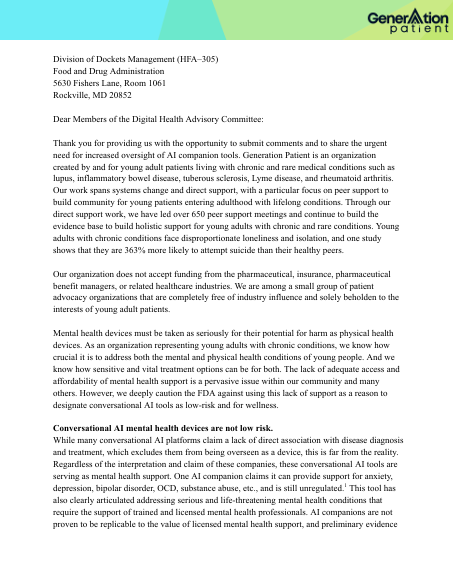
Generation Patient Public Comment to FDA Digital Health Advisory Committee Urging Regulation of AI Tools
In December 2025, Generation Patient submitted a comment to the Digital Health Advisory Committee within the Food and Drug Administration requesting that the FDA move to protect young people from the risks of AI tools.
Currently, many conversational AI platforms claim a lack of direct association with disease diagnosis and treatment, which excludes them from being overseen as a medical device. However, the reality is that many individuals are turning to conversational AI tools as mental health support, especially as many patients may encounter a lack of access and affordability of professional mental health support.
AI companions have not been proven to be replicable to the value of licensed mental health support. In the absence of FDA oversight, these tools are especially dangerous for young people, especially as interactions have facilitated a growing number of suicides in young people.
Urgent action is necessary. If you are interested in learning more or partnering with us, please email Sarah at sarah@generationpatient.org.