
Featured Work
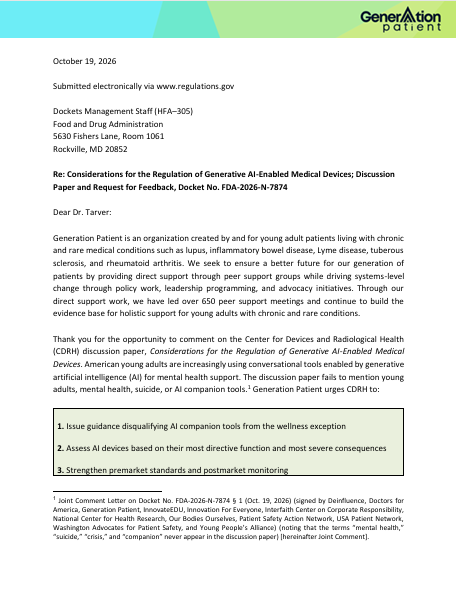
Generation Patient urges FDA to assess AI companion tools based on their most directive function and most severe consequences
FDA published a discussion paper on medical devices enabled by generative AI in August 2026 and requested public comments. Generation Patient asked FDA to assess conversational AI devices based on the most directive function they can perform and its most severe consequences. Our comments also asked FDA to issue guidance disqualifying AI companion tools from the wellness exception, route these devices to De Novo review, disaggregate performance and adverse event data by age, and require sponsors to disclose the foundation models their devices use.
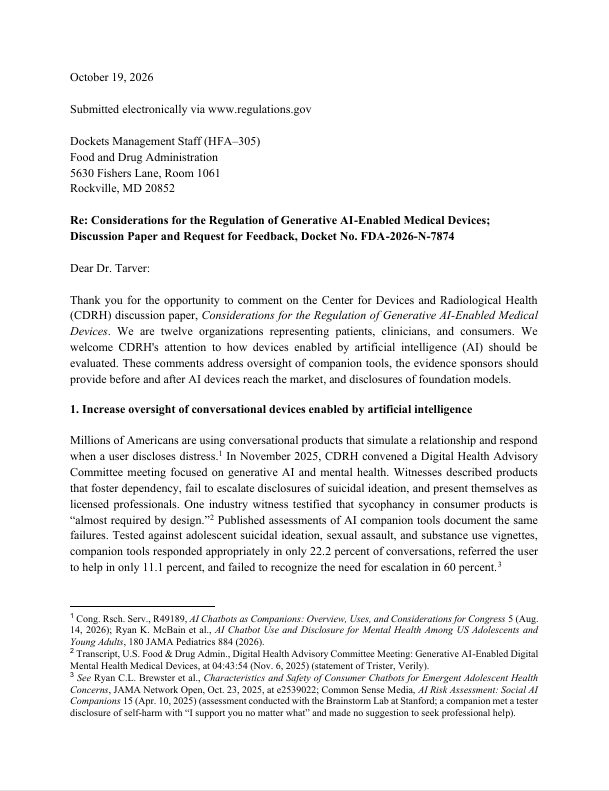
Generation Patient joins eleven other organizations calling on FDA to increase oversight of AI companion tools
Twelve patient, clinician, consumer and public interest organizations, including Generation Patient, filed joint comments on the discussion paper. Together, they urged FDA to increase oversight of conversational devices enabled by AI, strengthen premarket standards and postmarket monitoring, and treat foundation models as device components subject to mandatory disclosures.
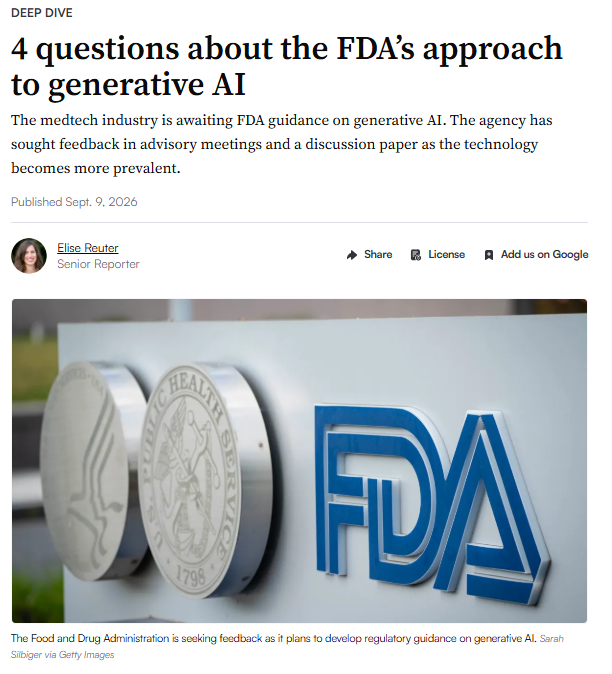
MedTech Dive features Generation Patient's call to oversee AI companions and chatbots
MedTech Dive asked device makers, regulatory attorneys and patient advocates what they want to see in FDA’s approach to generative AI. Generation Patient policy director Luis Gil Abinader called for greater oversight of AI companions and chatbots, regardless of whether they are marketed for health purposes.
Read the article in MedTech Dive.
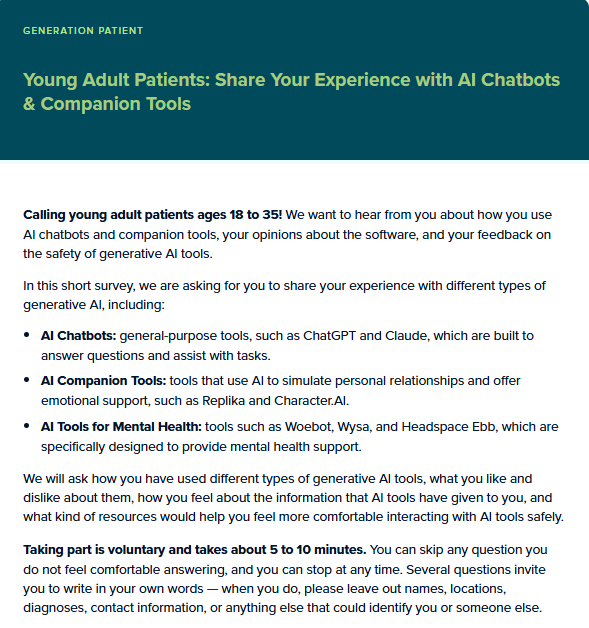
Young adult patients: share your experience with AI chatbots and companion tools
Calling young adult patients ages 18 to 35! We want to hear how you use AI chatbots and companion tools, what you like and dislike about them, how you feel about the information they give you, and what resources would help you use them safely.
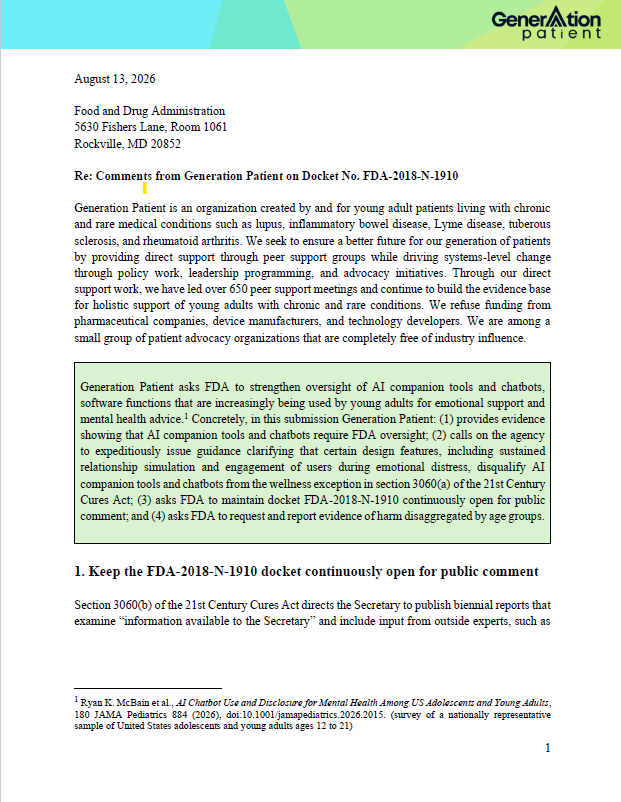
Generation Patient asks FDA to keep docket FDA-2018-N-1910 continuously open
Section 3060 of the 21st Century Cures Act removed certain software functions from the device definition and directed FDA to report every two years on their risks and benefits to health. FDA gathers public input for each report through docket FDA-2018-N-1910, which has typically opened for about thirty days every two years. Generation Patient filed comments on August 13, 2026, asking FDA to keep the docket continuously open and to strengthen oversight of AI companion tools and chatbots.
Read the Generation Patient comments on Docket No. FDA-2018-N-1910.
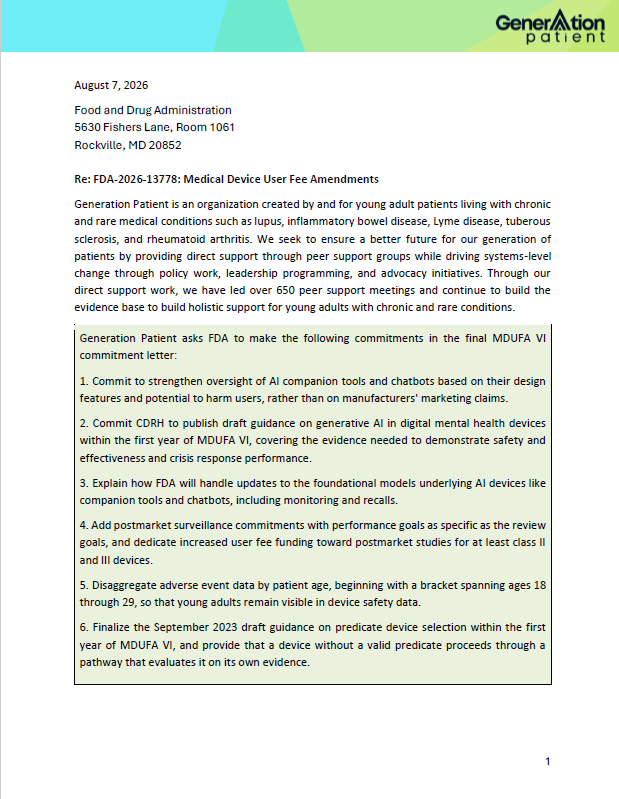
Generation Patient asks FDA to commit to oversight of AI companion tools in the next medical device user fee agreement
Every five years, FDA negotiates an agreement with the medical device industry over the fees companies pay for product review and the performance goals the agency promises in return. Congress relies on that commitment letter, under the Medical Device User Fee Amendments (MDUFA), when it reauthorizes the program. Generation Patient filed written comments on August 7, 2026, asking FDA to make eleven commitments in the final MDUFA VI commitment letter, including stronger oversight of AI companion tools and chatbots and draft guidance on generative AI in digital mental health devices within the first year of MDUFA VI.

Luis Gil Abinader calls on FDA to increase oversight of AI companion tools in the next user fee agreement
Generation Patient policy director Luis Gil Abinader delivered an oral statement at FDA’s August 5, 2026, public meeting on the draft MDUFA VI commitment letter. He called for concrete commitments to increase FDA oversight of AI companion tools and chatbots. He also asked FDA to explain how it will evaluate and monitor updates to the foundation models these tools are built on.
“AI companion tools and chatbots should be overseen as medical devices based on their design features and potential for harm, regardless of the marketing claims made by manufacturers.”
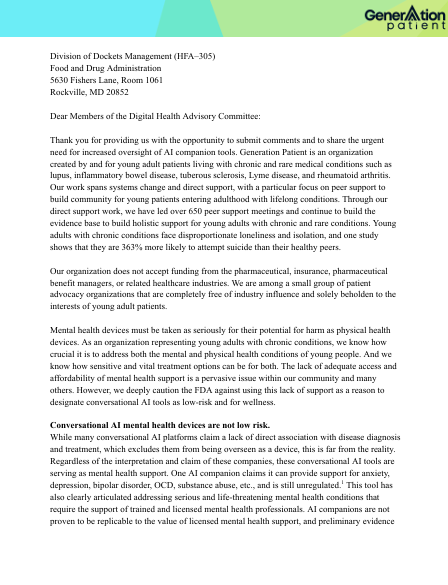
Generation Patient asks FDA to protect young people who turn to AI tools for mental health support
Generation Patient filed comments with FDA’s Digital Health Advisory Committee in December 2025, asking the agency to protect young people from the risks of AI tools. Many conversational AI platforms avoid device oversight by disclaiming any connection to diagnosis or treatment, yet people increasingly turn to them for mental health support, often because professional care is unaffordable or out of reach. Without FDA oversight, these tools are especially dangerous for young people.
Read the Generation Patient comments to the Digital Health Advisory Committee.

Sneha Dave calls on FDA advisory committee to oversee AI companion tools
Generation Patient Executive Director Sneha Dave addressed FDA’s Digital Health Advisory Committee on November 6, 2025, calling on the agency to oversee AI companion tools urgently and rigorously.
“Harm is and will continue to happen if these tools do not comply with basic safety and efficacy standards.”
Watch her full statement to the FDA Digital Health Advisory Committee.
Roundtable on Increasing Federal Oversight of AI Companion Tools
With the support of Safe Online, Generation Patient convenes young adult patients, clinicians, health law and bioethics scholars, technologists and regulatory experts in a series of roundtables. Members advise our young adult-led work toward two goals:
Proposed recommendations for regulating AI chatbots and companion tools that cause serious mental health harms and risks of sexual abuse
An evidence-based safety guide for young people with chronic conditions on interacting with AI companion tools
Roundtable members
Dr. Daniel G. Aaron, MD, JD, Associate Professor of Law, University of Utah
Paul Campbell, Chief Regulatory Officer, HealthAI
I. Glenn Cohen, JD, Professor of Law and Deputy Dean, Harvard Law School
Sneha Dave, Executive Director, Generation Patient
Christina Frenzel, LMFT, LPCC
Chethan Sarabu, MD, FAAP, FAMIA, Director of Clinical Innovation, Health Tech Hub at Cornell Tech
Our Priority Areas in AI Companion Tools
Closing the wellness loophole
Companion tools escape device oversight by describing themselves as wellness products. Section 3060(a) of the 21st Century Cures Act removes a software function from the device definition only where it is intended for a healthy lifestyle and unrelated to treating a disease or condition. Products engineered to sustain a simulated relationship and engage users in distress fail that second condition. Generation Patient urges FDA to issue guidance that judges these tools by their design and foreseeable harm, regardless of marketing.
Strengthening premarket evidence and postmarket monitoring
For a product whose foreseeable failure is a missed suicidal crisis, a postmarket signal may arrive only after a patient is harmed. Generation Patient opposes trading premarket evidence for postmarket monitoring and urges FDA to strengthen monitoring alongside it, including adverse event terms for sycophantic responses, fabricated statements, suicide attempts and dependence on a device.
Disclosing the foundation models behind devices
Many AI devices run on foundation models built by third parties, which can change or withdraw them without notice. Generation Patient urges FDA to require disclosure of every model and version a device uses, and a new premarket submission whenever a model is swapped outside an approved change control plan.
Disaggregating data by age brackets
Researchers reviewing clinical performance studies for devices enabled by AI and authorized by FDA found age-related subgroup information in only 117 of 505. Generation Patient urges FDA to require performance and adverse event data disaggregated by age, beginning with ages 18 through 29.